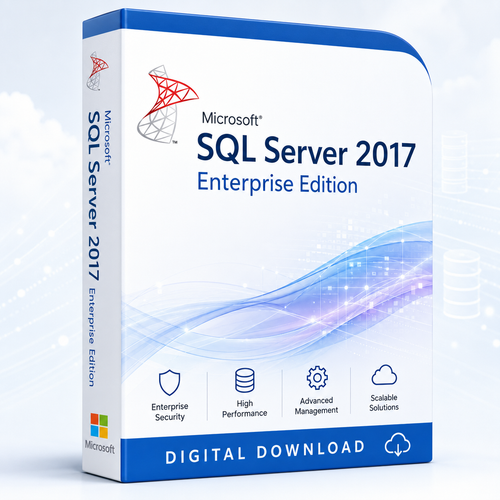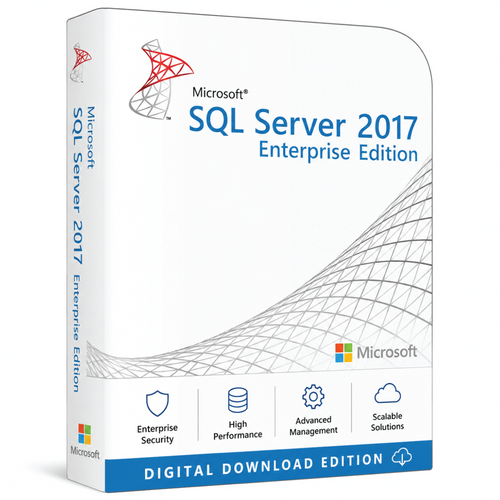
Microsoft SQL Server 2017 Standard
Run trusted business workloads on Windows or Linux with a standalone, perpetual licence and no recurring subscription.

Serious capability without Enterprise complexity
SQL Server 2017 Standard is designed for mid-tier applications, departmental databases, reporting and business intelligence.
Built for dependable transactional and analytical work
Windows and Linux
Deploy the relational engine across supported Windows Server, RHEL, SLES and Ubuntu environments.
Adaptive query processing
Selected query patterns can respond to real runtime conditions through adaptive joins and feedback.
Graph data support
Model complex relationships with node and edge tables while keeping familiar T-SQL tooling.
R and Python analytics
Bring analytical code close to governed business data through Machine Learning Services.
Modern T-SQL
Use STRING_AGG, TRIM, TRANSLATE, JSON functions, temporal tables and Query Store.
Layered data protection
Always Encrypted, row-level security, masking, backup encryption and auditing support defence in depth.

Protect sensitive data at several layers
Combine identity-aware controls, encryption and audit capabilities into a practical security architecture.
- Always Encrypted protects designated values from client to server.
- Row-level security applies data-access predicates inside the database.
- Dynamic data masking reduces casual exposure in query results.
- Backup encryption and auditing support protection and traceability.
Server + CAL or Per Core?
The correct model depends on users, devices, public access, cores, virtual machines and high-availability design.
Server + CAL
License each server, then provide a qualifying SQL Server CAL for every user or device that accesses it directly or indirectly.
- Often efficient for small, countable internal teams
- Choose User CALs or Device CALs consistently
- Multiplexing does not reduce CAL requirements
Per Core
License the physical server cores or virtual cores assigned to each licensed VM, subject to Microsoft licensing minimums.
- No SQL Server CALs required
- Suited to internet-facing workloads
- Core licences are commonly sold in two-core packs
Plan the platform before installation
These are Microsoft baseline requirements. Production sizing should follow the actual data, concurrency and recovery objectives.
Processor
x64, 1.4 GHz minimum; 2.0 GHz or faster recommended.
Memory
1 GB minimum; at least 4 GB recommended and more as the database grows.
Storage
6 GB minimum for setup; database, log, backup and tempdb space are additional.
Windows
Windows 8 / Server 2012 or later. Use a currently supported operating system.
Linux
Supported RHEL, SLES or Ubuntu versions; confirm the current Microsoft matrix.
Framework
.NET Framework 4.6 required for key Windows components; prefer a supported 4.x release.
SQL Server 2017 Standard vs Enterprise
| Capability | Standard | Enterprise | Decision impact |
|---|---|---|---|
| Database Engine compute | 4 sockets or 24 cores, whichever is lower | OS maximum | Per-instance processing headroom |
| Buffer pool memory | 128 GB | OS maximum | Memory-resident workload scale |
| Columnstore cache | 32 GB | Unlimited by edition | Analytical workload scale |
| Availability Groups | Basic AG: 2 replicas, 1 database | Full Always On AGs | High-availability topology |
| Transparent Data Encryption | Not included | Included | Database-file encryption at rest |
| Data compression and partitioning | Included | Included | Broadly available from SQL 2016 SP1 onward |
| Resource Governor | Not included | Included | Workload CPU and memory controls |
| Licensing | Server + CAL or Per Core | Primarily Per Core for new agreements | Can materially change total cost |
Compare SQL Server 2014–2025
Application certification, migration effort and support horizon should be considered together.
| Version | Platform | Defining capabilities | Support position | Best fit |
|---|---|---|---|---|
| 2014 | Windows | In-Memory OLTP; buffer pool extensions | Support ended | Existing certified legacy systems |
| 2016 | Windows | Query Store; temporal; JSON; Always Encrypted | Extended support ended July 2026 | Strict 2016 compatibility |
| 2017 — this product | Windows + Linux | Adaptive queries; graph; Python | Extended support to 12 Oct 2027 | Compatibility-led purchases |
| 2019 | Windows + Linux | Intelligent queries; ADR; UTF-8; TDE in Standard | Extended support to Jan 2030 | Measured modernisation |
| 2022 | Windows + Linux | Ledger; Azure SQL MI link; PSP optimisation | Extended support to Jan 2033 | Longer-horizon production |
| 2025 | Windows + Linux | Vectors; Fabric integration; larger Standard limits | Current release | Greenfield AI and modern data projects |
Evidence-led tuning for established workloads
Use adaptive query processing, Query Store, columnstore and In-Memory OLTP within Standard Edition limits.
- Query Store retains plans and runtime history to help locate regressions.
- Adaptive joins and memory grant feedback can improve selected analytical patterns.
- Columnstore supports faster scans and compression for analytical data.
- Memory-optimised tables target high-concurrency transaction workloads.

From checkout to deployment
Confirm licensing
Review users, devices, cores, VMs, failover and geography.
Checkout securely
Complete payment through the SSL/TLS-encrypted BigCommerce checkout.
Receive digitally
Get electronic fulfilment after payment and order verification.
Install with help
Use included guidance and optional free remote support.
Answers before you commit
Is SQL Server 2017 Standard a perpetual licence?
It can be supplied as a perpetual commercial licence rather than a recurring subscription. Your invoice and licence documentation should identify the exact product, quantity, model and use rights.
What licensing models are available?
Common options are Server + CAL and Per Core. Per Core is often suited to public-facing or high-user-count systems; Server + CAL requires a server licence plus CALs for users or devices.
How many cores can Standard Edition use?
A single SQL Server 2017 Standard Database Engine instance can use the lesser of four sockets or 24 cores. Licensing obligations are separate from the technical limit.
Does it run on Linux?
Yes. Confirm the exact RHEL, SLES or Ubuntu release and SQL Server cumulative update against Microsoft’s current support matrix.
When does Microsoft support end?
Mainstream support ended in October 2022. Extended support is scheduled to end on 12 October 2027.
Is SQL Server Management Studio included?
SSMS is a separate, no-cost Microsoft download used to administer SQL Server. It is not the server licence itself.
Do you provide installation help?
Yes. Software Mart Australia includes professional guidance and optional free remote support for download, installation and activation.
Should I buy 2017, 2022 or 2025?
Choose 2017 for a business-critical application certified for version 14.x. For a new long-life system, 2022 or 2025 usually offers a stronger support horizon and newer capabilities.
Can customers outside Australia purchase?
The store serves international customers. Use is subject to the supplied licence terms, export controls and any geographic restrictions confirmed during fulfilment.
Is checkout encrypted?
Checkout on SoftwareMart.com.au is protected with SSL/TLS encryption. Payment options and processing details are shown securely during checkout.
Choose the correct licensing model with expert guidance, complete encrypted checkout and receive verified digital fulfilment after purchase.
Review licensing options →