

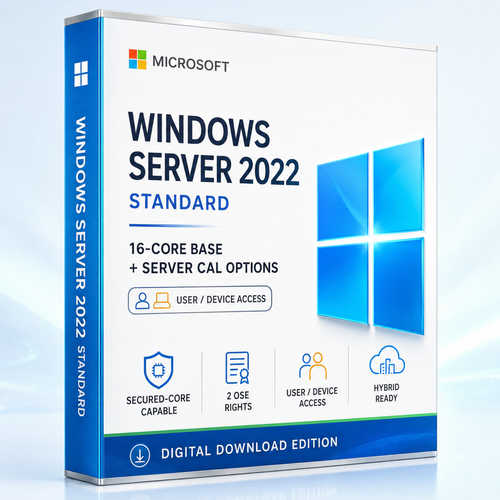
A complete server base with deliberately sized access
Microsoft Windows Server 2022 Standard + Server CALs
Build a clear Windows Server foundation with a base 16-core Standard licence pack, then select the Windows Server CAL quantity that matches the users or devices accessing it.
This retailer bundle offers 1, 2, 5, 10, 20, 30, 50 or 100 Windows Server CALs. CALs authorise access; they do not replace physical-core licensing, and Remote Desktop Services normally needs additive RDS CALs.
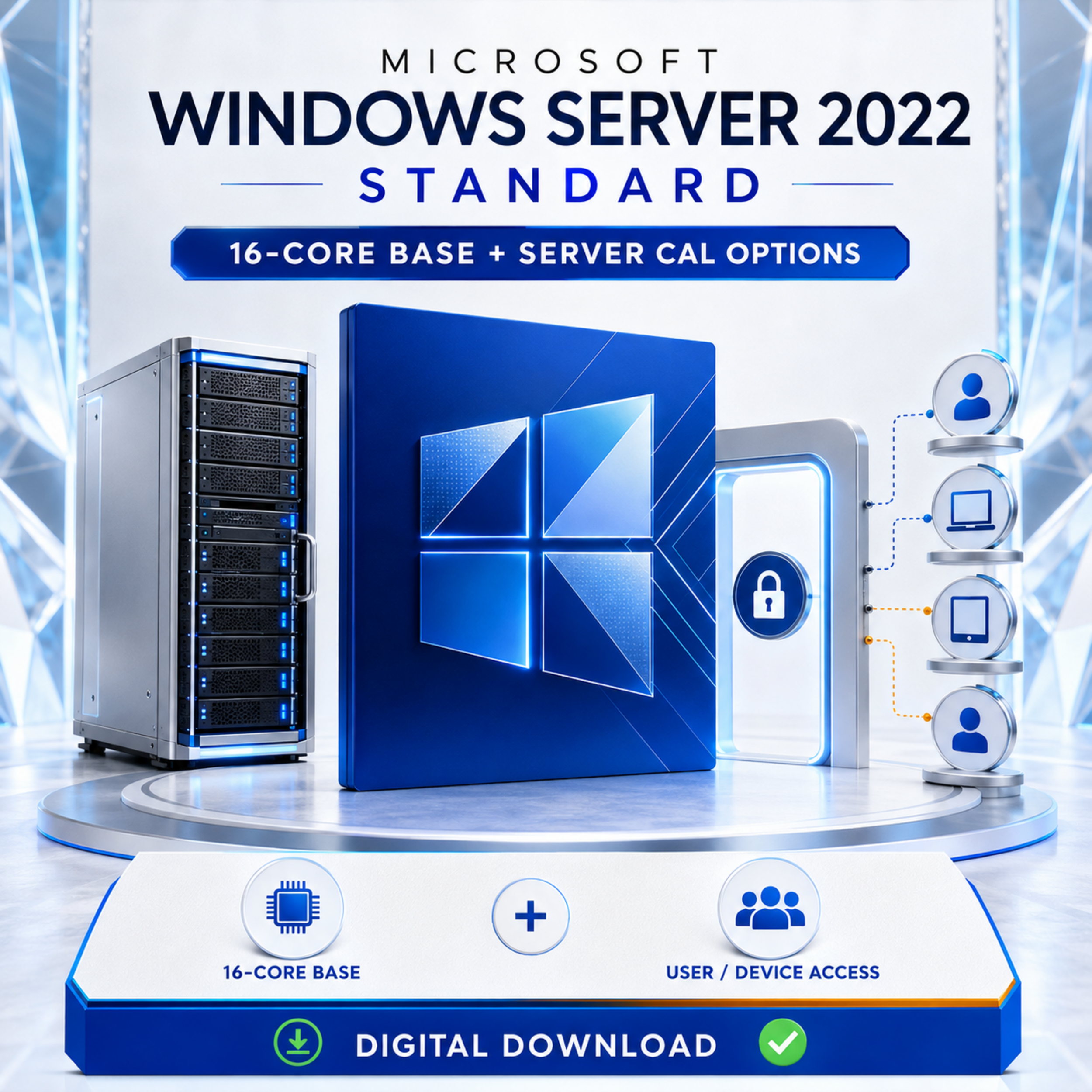
Know what the selector represents
“Server CAL License Edition” is a seller bundle—not a separate Microsoft technical edition
The operating system is Windows Server 2022 Standard. The listing combines a 16-core server licence base with a selectable access-licence quantity.

Server base
The server software is licensed against physical cores, subject to Microsoft’s eight-core-per-processor and sixteen-core-per-server minimums.

CAL quantity
Choose the listed CAL count only after identifying who or what will access Windows Server services.

User or Device
User CALs follow a person across devices; Device CALs cover a device used by people. Confirm which type the selected bundle supplies.

Evidence pack
Keep the invoice, product identifier, licence terms, CAL assignments, hardware inventory and activation records together.
Critical boundary
A Windows Server CAL does not licence the physical server and is not an RDS CAL. The complete design is server core licences + base Windows Server CALs + additive RDS CALs when Remote Desktop Services sessions are used.
Generation decision
Windows Server 2022 Standard vs Windows Server 2025 Standard
Choose 2022 when the application estate, vendor certification or operating model is already validated on it. Choose 2025 for a greenfield deployment that benefits from the newer platform and longer published lifecycle.
| Planning area | Windows Server 2022 Standard | Windows Server 2025 Standard |
|---|---|---|
| Lifecycle start | 18 August 2021 | 1 November 2024 |
| Mainstream support ends | 13 October 2026 | 13 November 2029 |
| Extended support ends | 14 October 2031 | 14 November 2034 |
| CAL version rule | 2022 CALs access 2022 or earlier | 2025 CALs access 2025 or earlier |
| Decision trigger | Existing certification, compatibility and operational baseline | Longer runway and newer platform capabilities |
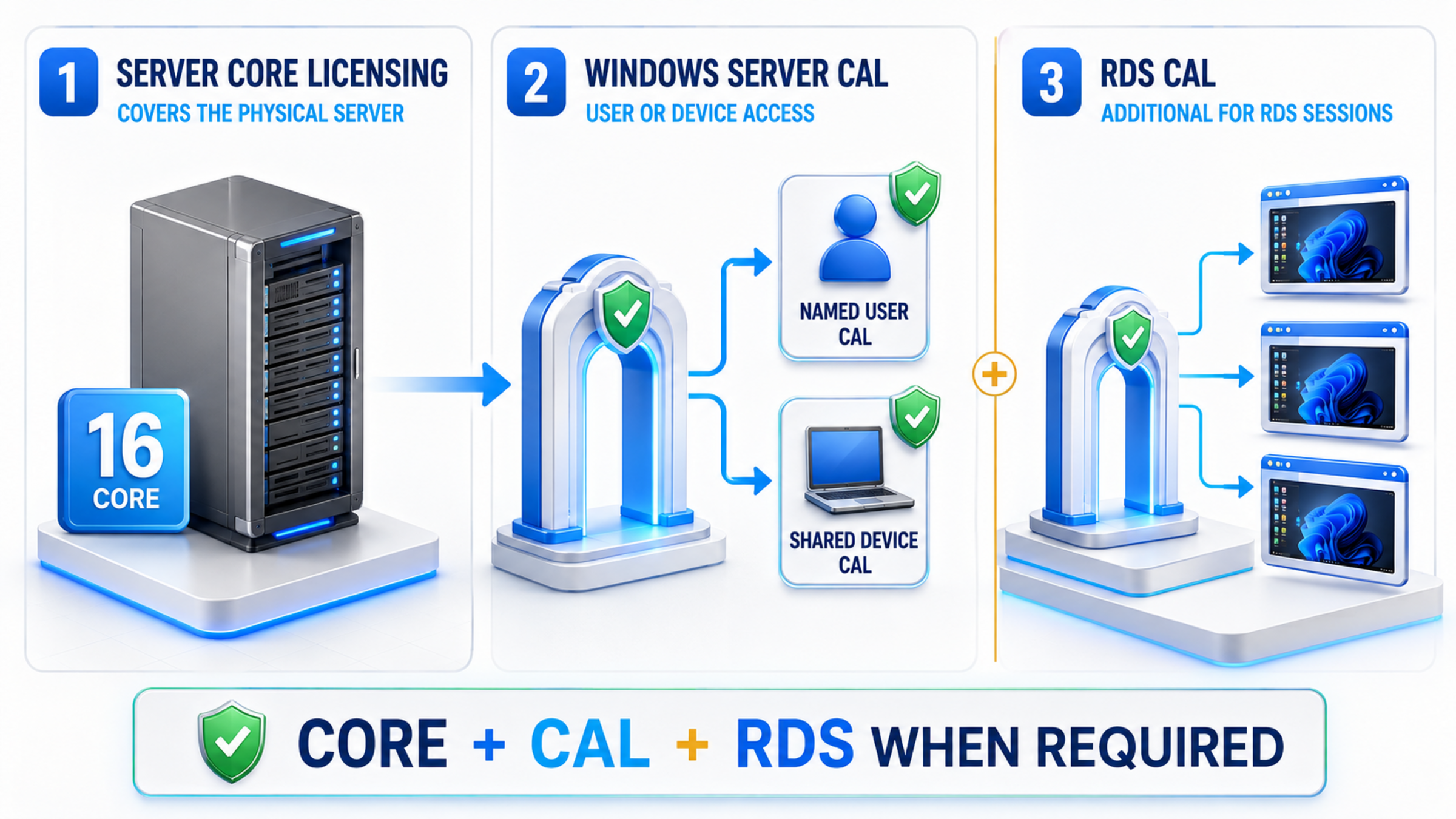
Three entitlements, three questions
Licence the server, the access and the remote session separately
- Physical server: cover every physical core, applying the licensing minimums.
- Normal server access: assign a Windows Server User CAL or Device CAL where required.
- Remote desktops or RemoteApp: add the corresponding RDS CAL and configure RDS licensing.
Administrative exception: the two Remote Desktop connections intended for server administration are not the same thing as deploying an RDS Session Host for business users.

RDS is an additive access layer
A base Windows Server CAL does not include the right to use an RDS Session Host for business desktops or applications. Add the matching RDS User or Device CAL and retain its assignment records.
Make the access count defensible
Select the right CAL type before selecting the quantity
The live listing describes “User/Device” CAL options. Ask the seller to confirm the supplied CAL type in writing; Microsoft treats User and Device CALs as different assignments.

User CAL
Best when one person accesses Windows Server from several devices: desktop, laptop, tablet or phone. Count assigned people, not simultaneous connections.

Device CAL
Best when several people share a smaller number of workstations, kiosks or shift terminals. Count assigned devices, not simultaneous connections.
| Decision | User CAL | Device CAL |
|---|---|---|
| Assigned to | One named user | One specific device |
| Best pattern | More devices than users; mobile or hybrid staff | More users than devices; shared terminals or shifts |
| Access scope | The assigned user can access the corresponding server version or earlier from their devices | People using the assigned device can access the corresponding server version or earlier |
| Common mistake | Buying only for peak concurrent users | Treating a device CAL as attached to an IP address or session |
| Before checkout | Confirm CAL type, version, quantity, assignment rules and proof of entitlement in writing. | |
Current retailer choices
Eight bundle sizes, one Windows Server edition
The selector changes the included access quantity. It does not change Standard’s features or physical-core rules.
| Listed option | Suitable starting pattern | Pre-purchase check |
|---|---|---|
| 16-core base + 1 CAL | Single administrator or very small access scope | Confirm whether the bundle supplies User CALs, Device CALs or a buyer-selected type. Recount every accessing user/device and add RDS CALs where required. |
| 16-core base + 2 CALs | Two assigned users or two shared devices | |
| 16-core base + 5 CALs | Small office or departmental role server | |
| 16-core base + 10 CALs | Compact business team | |
| 16-core base + 20 CALs | Growing office access estate | |
| 16-core base + 30 CALs | Mid-sized team or device fleet | |
| 16-core base + 50 CALs | Broader organisational deployment | |
| 16-core base + 100 CALs | Large access population requiring disciplined assignment records |
Live offer snapshot, 2 August 2026: the page displays a starting price of AU$752, SKU WINSER2022STD1USERCAL and UPC 889842425615. Recheck price, stock, identifier and selected CAL option immediately before publishing or checkout.
The 16-core base is a starting point
Confirm that the bundle covers the actual physical server
Microsoft requires all physical cores to be licensed, with at least eight core licences per physical processor and sixteen per server. A server with more than sixteen physical cores needs additional core licences.

Count physical cores
Count installed physical cores, not threads, logical processors or the number assigned to a VM.
Apply both floors
Every processor is treated as at least eight cores and every server as at least sixteen cores.

Repeat for more OSEs
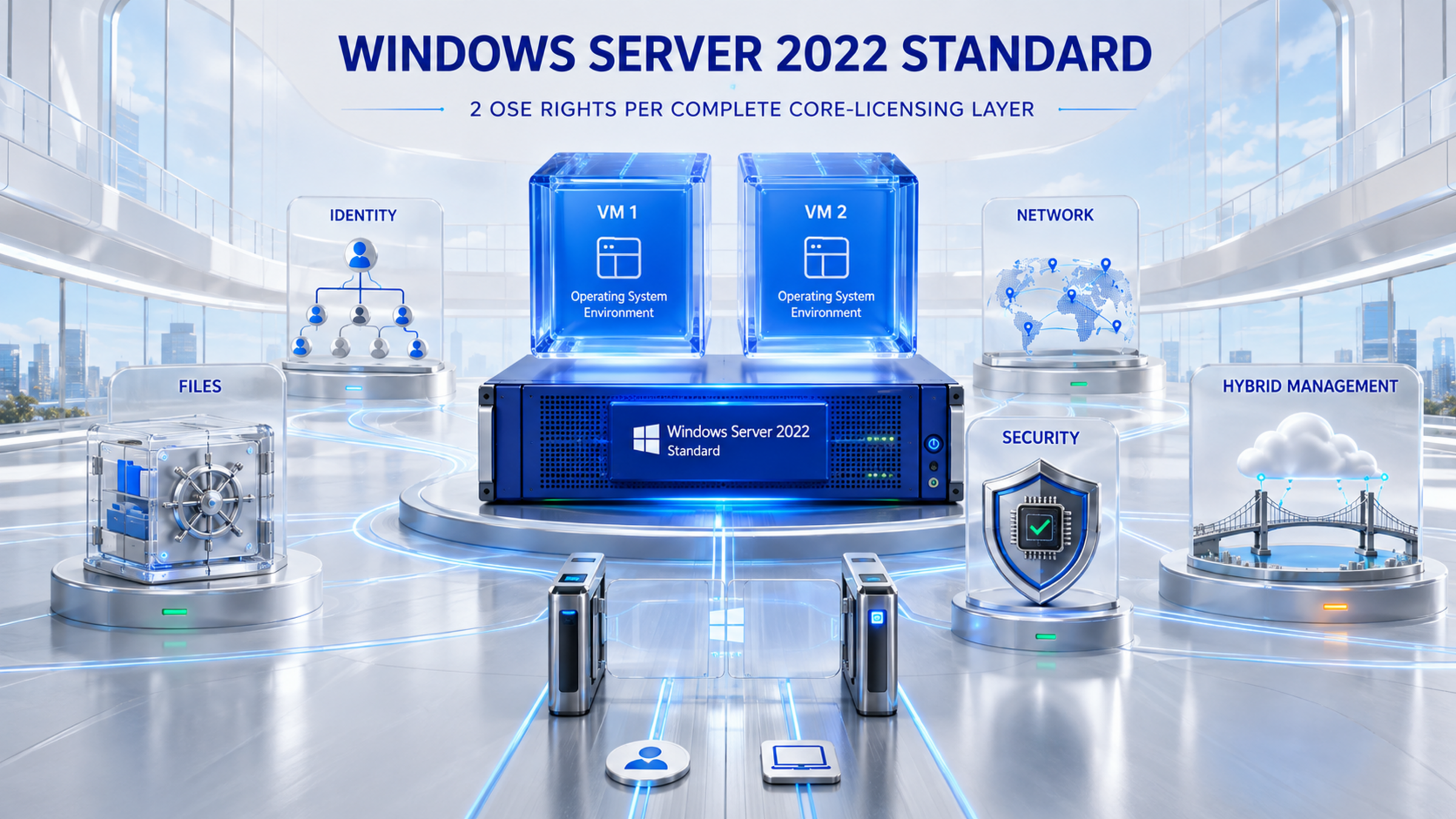
One complete server-wide Standard licensing layer permits two OSEs. Repeat the whole core layer for each additional pair.
| Physical server | Core licences required | Does the 16-core base cover it? |
|---|---|---|
| 1 CPU × 8 physical cores | 16 | Yes, because of the server minimum |
| 1 CPU × 16 physical cores | 16 | Yes |
| 1 CPU × 24 physical cores | 24 | No; add 8 core licences |
| 2 CPUs × 6 physical cores | 16 | Yes; each CPU is treated as at least 8 |
| 2 CPUs × 12 physical cores | 24 | No; add 8 core licences |
Built for essential business roles
Identity, files, networking, security and light virtualisation on one Standard platform
Windows Server 2022 Standard supports familiar infrastructure roles and hybrid management pathways. Its value is strongest when virtualisation density is modest and software-defined datacentre features are not required.
Virtualisation precision: the physical instance may run in addition to two virtual OSEs only when used solely to host and manage those virtual OSEs.

Identity
Active Directory Domain Services, Group Policy and certificate services for controlled business identity.

File services
SMB, DFS, quotas, deduplication, migration and managed storage workflows.

Network foundations
DNS, DHCP, IPAM and routing roles for resilient address and name services.

Hyper-V
Run supported Windows and Linux VMs within Standard’s applicable OSE rights.
Secure, compress and manage
Modern platform capabilities without Datacenter-only promises

Secured-core capable
Compatible hardware can combine TPM 2.0, Secure Boot, DRTM, DMA protection and VBS.

Hardware trust
Verify firmware and server-vendor support; secured-core protection is not created by the licence key alone.
TLS 1.3
Use modern transport security where applications, services and peers support the protocol.
SMB encryption
AES-256-GCM and AES-256-CCM support protects compatible SMB traffic under the configured policy.

SMB compression
Reduce supported transfer payloads without requiring application-side compression.

Containers
Containers without Hyper-V isolation are unlimited; Hyper-V-isolated containers count within Standard’s OSE limit.
Storage Replica
Standard is limited to one partnership and resource group with one volume up to 2 TB.
Hybrid pathways
Connect supported servers to Azure Arc and selected Azure services; subscriptions and service charges are separate.
Excluded from Standard 2022: Storage Spaces Direct, Network Controller, Host Guardian Hyper-V support, SMB over QUIC and hotpatching. The latter two belong to Datacenter: Azure Edition in the 2022 generation.
Edition decision
Windows Server 2022 Standard vs Datacenter
Core infrastructure roles overlap. Virtualisation density and software-defined datacentre requirements usually decide the edition.
| Decision factor | Standard | Datacenter |
|---|---|---|
| Physical-core minimums | All physical cores; 8 per processor and 16 per server | Same minimums |
| Virtual OSE rights | Two per complete server-wide licensing layer | Unlimited on the fully licensed server |
| Base Windows Server CALs | Required for qualifying user/device access | Same CALs; no special Datacenter CAL |
| Storage Replica | One partnership/resource group; one volume up to 2 TB | Unlimited |
| Storage Spaces Direct | Not included | Included |
| Network Controller | Not included | Included |
| Typical fit | Physical roles and light virtualisation | Dense virtualisation and software-defined datacentre |
Installation and administration
Choose the operational model before setup
Server Core and Desktop Experience are installation options, not licence models. Switching between them later requires a clean installation.

Server Core
Minimal footprint, managed locally with SConfig and PowerShell or through remote tools.

Desktop Experience
Familiar graphical shell and broader local-UI compatibility, with a larger installed footprint.

Windows Admin Center
Use a modern browser-based console for supported server, cluster and hybrid workflows.

PowerShell
Automate repeatable deployment, role configuration, reporting and CAL-inventory workflows.
| Component | Microsoft baseline | Planning note |
|---|---|---|
| Processor | 1.4 GHz 64-bit x64 with required instruction-set capabilities | Verify server-vendor support, firmware and virtualisation extensions. |
| Memory | Release and installation-option dependent; Microsoft documents 2 GB baselines in the consolidated guidance | Size for roles, VMs, agents and recovery; use ECC or similar on physical hosts. |
| System storage | 32 GB absolute minimum | Provide substantially more for updates, paging, logs, roles and dumps. |
| Network | PCIe-compatible Ethernet capable of at least 1 Gbps | Design redundancy and throughput for storage, backup and application traffic. |
| Secured-core | IOMMU, Kernel DMA Protection, DRTM, TPM 2.0, Secure Boot and VBS support | Use compatible hardware and enable every required feature. |
Fixed Lifecycle
Mainstream support ends soon; Extended Support continues to 2031
Windows Server 2022 started on 18 August 2021. Mainstream support ends 13 October 2026 and Extended Support ends 14 October 2031.
For a new deployment, compare application certification and migration cost with Windows Server 2025, whose published support horizon extends further.

Lifecycle checkpoints
- Start: 18 August 2021
- Mainstream end: 13 October 2026
- Extended end: 14 October 2031
- Container images follow the same lifecycle.
Order workflow
Move from access inventory to a verifiable purchase
Inventory
Record processors, physical cores, OSEs, people, shared devices and RDS use.
Choose
Select User or Device CALs, then choose the quantity that covers every required assignment.
Confirm
Verify licence channel, CAL type, media, activation, documentation and delivery in writing.
Preserve
Keep entitlement, assignments, core calculation and activation records with the server asset.

Electronic fulfilment
The seller advertises email delivery and an official download link. Prepare the server, maintenance window, backups and Microsoft account first.
Support context
The seller advertises remote installation support. Confirm whether the scope stops at download, installation and activation or includes migration and role configuration.
Frequently asked questions
Windows Server 2022 Standard Server CAL bundle: 30 practical answers
1. Is “Server CAL License Edition” a Microsoft edition?
No. The technical edition is Windows Server 2022 Standard. The phrase describes this seller’s bundle of a 16-core base plus Windows Server CAL options.
2. What does the base 16-core pack do?
It starts the physical-server licensing layer. A server with more than sixteen physical cores needs additional core licences.
3. What does a Windows Server CAL do?
It grants an assigned user or device access to corresponding or earlier Windows Server software, subject to the Product Terms.
4. Does a CAL include Windows Server itself?
No. CALs are access rights. The physical server still needs sufficient Windows Server core licences.
5. Which CAL quantities are listed?
The current selector shows 1, 2, 5, 10, 20, 30, 50 and 100 CAL options, each with the base 16-core pack.
6. Is a User CAL concurrent?
No. It is assigned to a user. Do not size User CALs only for the peak number of simultaneous sessions.
7. When should I choose a User CAL?
When staff commonly access the server from multiple devices and the number of people is lower than the number of devices.
8. When should I choose a Device CAL?
When multiple people share a smaller number of workstations, kiosks or shift terminals.
9. Can I mix User and Device CALs?
Organisations can use both types when assignments are tracked correctly, but confirm what this bundle provides and document each assignment.
10. Does one CAL cover every Windows Server?
A valid CAL can permit its assigned user or device to access customer licensed servers running the corresponding version or earlier, subject to the terms.
11. Can a Windows Server 2022 CAL access Server 2019?
Yes. Microsoft’s version rule allows a corresponding CAL to access that version or earlier versions.
12. Can a Windows Server 2022 CAL access Server 2025?
No. A 2022 CAL does not grant access to a later Windows Server version.
13. Do I need RDS CALs?
Yes when users or devices connect to an RDS Session Host for desktops or applications. RDS CALs are additive to base Server CALs.
14. Are two admin Remote Desktop connections RDS deployment rights?
No. Administrative connections are for managing the server; providing remote desktops or apps to users is an RDS workload.
15. Does a CAL activate the server?
No. CAL assignment, software activation and the server core entitlement are separate concepts.
16. Do I count CPU threads for the server licence?
No. Under the physical-core model, count physical cores and then apply the per-processor and per-server minimums.
17. What if my server has 24 physical cores?
The 16-core base is short by eight core licences. Add sufficient core packs before deployment.
18. How many virtual OSEs does Standard permit?
Two per complete licensing layer covering the server. Re-license every physical core for each additional pair.
19. Is the Hyper-V host instance additional?
Only when the physical OSE is used solely to host and manage the virtual OSEs.
20. Does Standard include Hyper-V?
Yes. Hyper-V is available, subject to compatible hardware, configuration and the applicable OSE rights.
21. Does it include Active Directory and file services?
Yes. Standard supports AD DS, DNS, DHCP, Group Policy, SMB file services and many familiar infrastructure roles.
22. Does Standard include Storage Spaces Direct?
No. Storage Spaces Direct is a Datacenter capability in the 2022 generation.
23. What is Standard’s Storage Replica limit?
One partnership and one resource group with one volume up to 2 TB.
24. Is SMB over QUIC included?
No. Microsoft lists SMB over QUIC for Windows Server 2022 Datacenter: Azure Edition, not Standard.
25. Is hotpatching included?
No. Hotpatching in the Windows Server 2022 comparison belongs to Datacenter: Azure Edition.
26. Can I choose Server Core or Desktop Experience?
Yes. Choose during setup; converting between those installation options later requires a clean installation.
27. What is the minimum system drive size?
Microsoft lists 32 GB as an absolute minimum. Real deployments need substantially more for updates, logs, paging, roles and recovery.
28. What is the support lifecycle?
Mainstream support ends 13 October 2026 and Extended Support ends 14 October 2031.
29. What should I verify before buying?
Confirm the CAL type, count, licence channel, core quantity, activation, media, region, transfer rights, documentation and support scope.
30. What records should I retain?
Keep the invoice, product identifier, licence terms, CAL assignment register, hardware inventory, core calculation and activation records.
Licence the server. Size the access. Keep the evidence.
Choose a Windows Server 2022 Standard bundle that matches the real estate
Confirm physical cores, select User or Device CALs, add RDS CALs when required and preserve every entitlement record.