

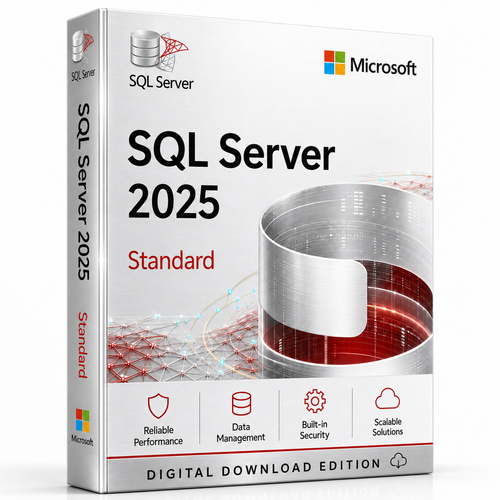
Microsoft SQL Server 2025 Standard Edition
More capacity, stronger control and an AI-ready data engine.
Buy Microsoft SQL Server 2025 Standard Core Licence for secure operational databases, business applications, reporting and modern AI retrieval workloads—with 32-core capacity, a 256 GB buffer pool and Resource Governor now in Standard Edition.

The practical leap
More headroom. Better control. A cleaner path to modern applications.
SQL Server 2025 Standard is a production database edition for organisations that need serious relational performance while keeping licensing and operations proportional to mid-tier workloads.

Capacity that moves with the workload
The per-instance Standard ceiling rises from 24 to 32 cores, while buffer-pool memory doubles from 128 GB to 256 GB.

AI-ready data stays close to SQL
Native vectors, embedding workflows, JSON indexing and external model connections support modern retrieval and application patterns.

Workload governance reaches Standard
Resource Governor now helps Standard Edition DBAs classify workloads and place limits around competing resource demands.

AI-ready data engine
Build the intelligent application. Keep the data close.
SQL Server 2025 brings vector, JSON and AI integration patterns into the database platform your teams already secure, monitor and query. The result is a more direct route from governed operational data to semantic search, assistants and modern APIs.
Preview note: vector indexing, regular expression features and change event streaming include preview capabilities. Microsoft does not recommend preview features for production workloads.
Vector data inside the engine
Store and query embeddings alongside relational data for semantic retrieval patterns.
Vector index is preview
Embeddings and external models
Generate embeddings and connect governed external AI models without moving the system of record.

Native JSON, indexed
Use the native JSON type and JSON index for flexible application payloads with SQL joins and governance.

External REST endpoints
Invoke carefully governed REST endpoints from T-SQL for service integration and automation.

Richer text matching
Regular-expression functions and fuzzy matching broaden cleansing, matching and search scenarios.
Selected features are preview
Events and analytics paths
Change event streaming and Fabric mirroring connect operational data to analytical experiences.
Performance and control
More predictable performance is a feature—not a tuning accident.
Higher capacity is paired with workload controls and query-processing improvements for mixed estates.
Resource Governor
Classify workloads and allocate resource pools or workload groups for more predictable coexistence.

Optimised locking
Reduce lock memory and blocking for qualifying write-heavy workloads.

tempdb space governance
Apply guardrails to temporary-space consumption and protect shared instances.

Plan-sensitive optimisation
PSPO and Optional Parameter Plan Optimisation improve plans for uneven parameter distributions.
Optimised sp_executesql
Serialise compilation of identical batches to reduce duplicate plan creation under concurrency.

Modern analytical options
Columnstore, in-memory OLTP and Query Store support operational analysis within Standard limits.
Security and resilience
Protect the data path from file to application.
Standard Edition includes the controls to build layered protection. Encryption is one layer; identity, least privilege, auditing, backups and tested recovery remain essential.
- Transparent Data Encryption and encrypted backups
- Always Encrypted, auditing and row-level security
- Basic Availability Groups or two-node FCI designs


Transparent Data Encryption
Encrypt database files at rest and integrate encrypted backups into recovery operations.

Always Encrypted
Protect sensitive values with client-side keys, including supported secure-enclave scenarios.

Fine-grained protection
Combine row-level security, masking, auditing, classification and least-privilege permissions.
Edition comparison
Standard, Enterprise or Express?
Standard is compelling when the workload fits its compute, memory and availability limits. Enterprise becomes a design requirement when advanced scale, full Availability Groups or advanced online operations are essential.
| Capability | Standard 2025 | Enterprise 2025 | Express 2025 |
|---|---|---|---|
| Best fit | Mid-tier production | Mission-critical scale | Learning and small apps |
| Compute per instance | Lesser of 4 sockets or 32 cores | Operating-system maximum | Lesser of 1 socket or 4 cores |
| Buffer-pool memory | 256 GB | Operating-system maximum | 1,410 MB |
| Maximum relational DB | 524 PB | 524 PB | 50 GB |
| Resource Governor | Included | Included | Not included |
| Availability Groups | Basic AG: 2 replicas, 1 DB | Full AG | Not included |
| Failover Cluster Instance | 2 nodes | OS maximum | Not included |
| Vector + native JSON | Included* | Included* | Included* |
*Some associated capabilities, including vector indexing, remain preview. Verify the current Microsoft feature matrix.
Why 2025 is a meaningful Standard release.
| Standard capability | 2019 | 2022 | 2025 |
|---|---|---|---|
| Compute per instance | 24 cores | 24 cores | 32 cores |
| Buffer pool | 128 GB | 128 GB | 256 GB |
| Resource Governor | Not in Standard | Not in Standard | Included |
| Native vectors | — | — | Included |
| Native JSON type/index | — | — | Included |
| Extended support ends | 2030 | 2033 | 2036 |
License the architecture
Per Core makes access simple. Counting the cores still matters.
Per Core removes the need to count users or devices, but the required quantity is determined by the deployed physical or virtual architecture.
Per Core
Best for broad or unpredictable access.
- No SQL Server CALs required
- Core licences sold in 2-core packs
- License relevant physical cores or eligible assigned vCores
- Four-core minimum rules apply
- Confirm Software Assurance for individual virtual OSE licensing

Server + CAL
Best for a small, stable access population.
- Server licence plus user or device CALs
- Every accessing user or device must be covered
- Multiplexing does not reduce CAL requirements
- Less suitable for public access

A 2-core pack is a building block—not a default standalone licence.
Microsoft’s core terms require at least four core licences per physical processor or per licensed virtual OSE. The SQL Server 2025 retail terms also state that virtual-core licensing for licences acquired on or after 16 November 2022 is available only with active Software Assurance. “Unlimited users” means CAL-free access under Per Core; it does not override core minimums or the 32-core technical ceiling per Standard Database Engine instance.
System requirements
Plan the operating environment before licence assignment.
These are Microsoft installation baselines, not production sizing targets.
Digital fulfilment
Know exactly what arrives—and what support follows.
Delivery email contents
Your email includes the product licence key, download link and installation instructions.
Typically 1–10 minutes
Orders are normally delivered by email within 1–10 minutes after successful payment and any required order checks.
Installation support
Support is available through remote assistance, live chat, email and phone for download, installation and activation.
Technical and commercial FAQ
Answers for architects, DBAs and procurement teams.
Who is SQL Server 2025 Standard for?
Mid-tier production applications, departmental systems, operational reporting and organisations that need strong security without Enterprise-only scale.
Is SQL Server 2025 generally available?
Yes. Microsoft lists general availability from 18 November 2025. Individual preview features still require separate evaluation.
What is the Standard compute limit?
The lesser of four sockets or 32 cores for one Database Engine instance.
How much buffer-pool memory is supported?
256 GB per Database Engine instance. Feature-specific caches have separate limits.
What does “unlimited users” mean?
SQL Server CALs are not required for users or devices under a correctly licensed Per Core deployment. It is not a separate CAL bundle.
Is one 2-core pack enough?
Usually no. Four-core minimums generally apply per physical processor or per licensed VM.
How are physical servers licensed?
License every physical core in each processor running SQL Server, subject to a four-core minimum per processor.
How are virtual machines licensed?
Licensing an individual virtual OSE uses its assigned virtual cores with a four-core minimum. Microsoft’s SQL Server 2025 retail terms state that virtual-core licensing for licences acquired on or after 16 November 2022 is available only with active Software Assurance; confirm the exact entitlement before purchase.
Do Per Core licences need CALs?
No, provided the deployment is correctly licensed under Per Core.
Is Server + CAL available?
Yes for Standard Edition. It can suit a small, countable user or device population.
Does Standard include Resource Governor?
Yes. SQL Server 2025 adds Resource Governor to Standard Edition.
Does it support vector data?
Yes. Native vector data and functions support embedding and similarity workflows.
Is vector indexing production-ready?
Microsoft currently marks vector indexes preview and does not recommend preview features for production.
What changed for JSON?
SQL Server 2025 adds a native JSON type and JSON index.
Can it call external AI models?
Yes, with external model and embedding-generation capabilities. Apply provider, network, security and cost governance.
What HA is included?
Basic AG with two replicas for one database, two-node FCI, log shipping and supported recovery patterns.
Does Standard include full Availability Groups?
No. Full AG topologies remain Enterprise-oriented.
Is TDE included?
Yes, along with encrypted backup support and wider security controls.
Is Always Encrypted included?
Yes, including supported secure-enclave capabilities subject to deployment and driver requirements.
Can Standard upgrade to Enterprise?
Yes in supported edition-upgrade scenarios. Test dependencies and rollback planning first.
Which Windows Server baseline is supported?
Microsoft documents Windows Server 2019 and later supported releases. Verify the current requirements table.
How long is SQL Server 2025 supported?
Mainstream support runs to 6 January 2031 and extended support to 6 January 2036.
Why might a store offer 64 cores?
A larger quantity can cover multiple processors, VMs or instances; it does not raise one Standard instance above its 32-core limit.
What should I confirm before buying?
Licensing model, core or CAL count, topology, Software Assurance needs, OS support, fulfilment contents and any Enterprise-only or preview dependencies.
Primary Microsoft sources
Verified detail for a confident decision.
Ready for the next workload?
Move to SQL Server 2025 Standard with the architecture—and licence count—already understood.