

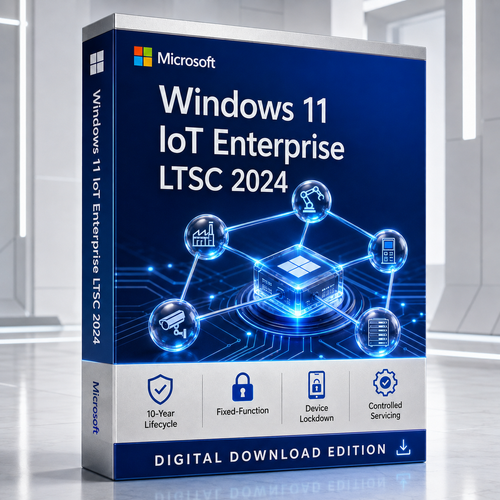
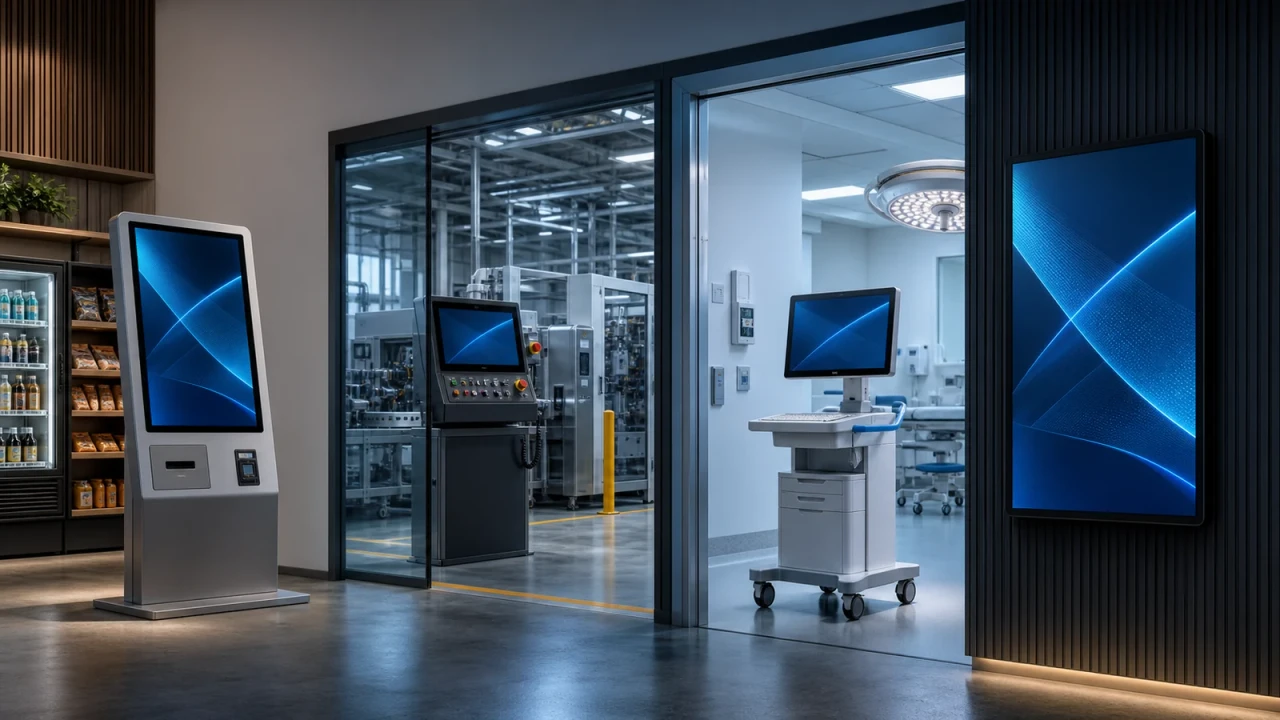
Essential buying distinction: this edition is intended for special-purpose, fixed-function devices. It is not a substitute for a general-purpose employee desktop licence. Digital delivery does not change the rights, qualifying requirements or activation rules of the underlying Microsoft offer.
Procurement clarity
Confirm the deployment right—not merely the key.
This listing uses Microsoft manufacturer part number DG7GMGF0PP49-0001 and is offered in selectable device-count packs. Before rollout, confirm the commercial channel, qualifying operating system, activation method, media access, reassignment rights and proof-of-licence requirements for your organisation.
Fixed function
Define the device's dedicated job, users, applications, peripherals and expected field life.
Licence programme
Confirm the offer channel, qualifying base OS, permitted use and reassignment conditions.
Media and activation
Verify architecture, installation media, activation method and deployment tooling before purchase.
Records and support
Retain invoices, agreement records, keys and deployment evidence with the device lifecycle plan.
The operational case
When the device has one job, platform change becomes a business risk.
For regulated, validated or remotely deployed endpoints, an annual feature transition can trigger application testing, field visits and documentation work. LTSC holds the feature foundation to the 2024 release while monthly quality and security updates continue.
Self-service and POS
Present a curated interaction model and service it around the life of the deployed device.
Production controls
Keep defined workloads stable at the edge while retaining familiar Windows management approaches.
Specialised systems
Support deliberate validation, controlled change and dependable recovery for dedicated clinical workflows.
Information displays
Keep the audience focused on the content and workflow the endpoint was designed to deliver.

Edition comparison
Choose by permitted role, cadence and lifecycle.
A familiar Windows platform runs underneath each edition, but the licensing intent and servicing model materially change the decision.
| Decision factor | IoT Enterprise LTSC 2024 | Enterprise LTSC 2024 | IoT Enterprise GAC |
|---|---|---|---|
| Intended role | Fixed-function specialised devices | Eligible special-use Enterprise scenarios | Fixed-purpose devices needing current feature cadence |
| Feature servicing | Static LTSC foundation | Static LTSC foundation | Feature updates follow the applicable release |
| Support horizon | Through 10 October 2034 | Through 9 October 2029 | Varies by release |
| Best-fit signal | Long-lived, validated, change-controlled endpoint | Eligible special-use deployment needing a five-year horizon | Dedicated endpoint that benefits from newer platform features |
Operational guidance only. Always check the current Microsoft Product Terms and your organisation's agreement.

Hardware planning
Start with the preferred minimum. Deviate only with evidence.
Microsoft permits specialised-device flexibility, but a lower specification transfers responsibility to image engineering, compatibility testing and lifecycle monitoring.
Preferred starting bar
1 GHz, 2-core processor · 4 GB RAM · 64 GB SSD · UEFI · TPM 2.0 · Secure Boot · DirectX 12 · 9-inch 720p display.
Specialised-device minimum
1 GHz, 2-core processor · 2 GB RAM · 16 GB storage · BIOS permitted · TPM and Secure Boot optional · DirectX 10 or none · custom display.
Minimum is not production-ready. Validate supported processors, drivers, storage endurance, update headroom, application memory, recovery partitions and every attached peripheral.
Buyer FAQ
Answers for architects, procurement and operations.
What is Windows 11 IoT Enterprise LTSC 2024?
A full Windows Enterprise operating-system edition designed and licensed for special-purpose, fixed-function devices. The 2024 LTSC release is based on Windows 11 version 24H2 and has a ten-year support lifecycle.
Is it suitable for an ordinary employee desktop?
No. Microsoft states that Windows IoT Enterprise LTSC is intended for fixed-function specialised devices and cannot replace Windows desktop licensing for general-purpose computing.
Does LTSC receive security updates?
Yes. Applicable monthly quality and security updates continue during the lifecycle; the LTSC feature foundation does not move automatically to a later LTSC release.
Which architectures are supported?
Microsoft documents Windows IoT Enterprise for x64 and Arm64. Confirm that the supplied media, licence, hardware, drivers and application stack support your chosen architecture.
Does digital delivery define the licence rights?
No. The licence programme and applicable agreement define the rights. Confirm eligibility, activation, permitted use, reassignment, media and proof of licence before purchase.
What should be tested before rollout?
Validate hardware, firmware, security, drivers, peripherals, application behaviour, lockdown, servicing, recovery, remote management, storage growth and rollback.
A dependable endpoint starts with the right edition, rights and design.
Confirm the fixed-function scenario and fulfilment requirements, then build the deployment around evidence—not assumptions.
Research foundation: Microsoft product overview · Lifecycle · Licensing · System requirements · Device lockdown